

Kenya Flying Labs has joined hands with a Swiss partner to test a new drone-based solution to monitoring congestion in urban areas.
In a report, the Kenyan custodian of WeRobotics’ Flying Labs network of drone robotics services entrepreneurs said it partnered with the Swiss Federal Institute of Lausanne’s (EPFL) Laboratory of Urban Transport Systems (LUTS) and parent organisation WeRobotics to test out the laboratory’s new traffic monitoring system, which incorporates drone technology.
“Drones provide excellent visibility, can cover large areas, and are relatively affordable,” says Manos Barmpounakis, a post-doc researcher at LUTS. “What’s more, they offer greater precision than GPS technology and eliminate the behavioural biases that occur when people know they’re being watched. And we use drones in a way that protects people’s identities.”
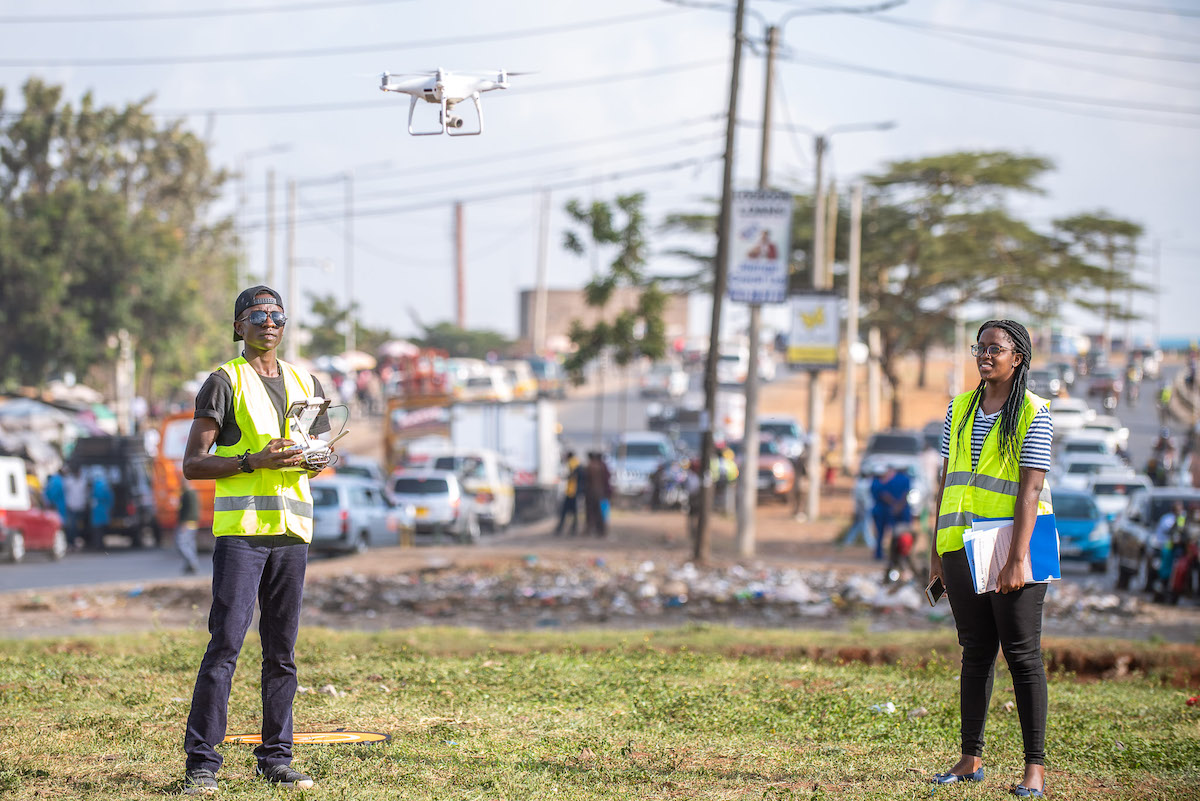
The partners recently took the new solution for some pilot tests in the streets of Nairobi, choosing the major boulevards of Ngong and Jogoo. Remarkably, it also marked the first time a swarm of drones have flown legally in the lower skies of the Kenyan capital, a complex urban environment that required special permits from the aviation regulator and also the special flying skills of the drone pilots involved.
“The swarm of drones of the experiment involved five drones on each road, for a combined total of ten drones,” Kenya Flying Labs said in its report. “This translated to bringing together a team of ten certified drone pilots and supplementing each pilot with an assistant/spotter. The drones – a mix of DJI Phantom 4 Pro and Mavic 2 Pro – were coordinated to fly during the morning traffic peak hours (6:30–9AM) and the evening traffic peak hours (4–6:30PM) over four days to meet EPFL’s data requirement needs.
“In addition, Kenya Flying Labs’ team coordinated with the traffic police on Jogoo and Ngong roads for smooth operations and the Moi Air Base control tower, which was always kept abreast of daily operations via mobile phone calls before and after each mission.”
The team recorded 87 hours of video, which – as explained by the head of LUTS, Professor Nikolas Geroliminis – would then be fed into software with algorithms that would identify sources of congestion. The resultant information would be given to traffic authorities to act based on what id actually on the ground.
The implementation phase of the programme has not been without its challenges however, not least of which is the presence of unique means of public transportation in Nairobi. When it was first tested, LUTS’s system was put into action in the streets of Athens, Greece, where traffic was orderly.
But in Kenya, the new system had to contend with matatus, the public transport service providers that brazenly flout road regulations, rendering to naught all the smart intricacies of the congestion algorithms.
"The Nairobi experience is unique, not only in terms of size, but also in flying in a very demanding environment," said Barmpounakis. “Nairobi is one of the most congested cities in the world and it is very difficult to model and monitor traffic. “Anyone who has been to the Kenyan capital knows that transportation is dominated by matatus, the collective minibuses that drop off and pick up passengers according to demand in an indescribable road chaos. Matatus are self-organised and self-managed means of public transport and while they have many similarities with conventional public transport, traditional approaches are not directly applicable.”
The team also had to deal with other issues, which included overall design of the experiment with drones (defining the right number of drones needed, where to fly, and for how long); transforming the video images into usable data for our purposes; and analysing this data to find the sources of congestion.
“The most important learnings made with this experiment were around the complexity of carrying out such operations in urban Nairobi and the effort required to secure the flight permits, organize the logistics, and successfully manage all the logistics,” Kenya Flying Labs concluded.
“It became evident from the earliest moment that the key success factors to such a project are local knowledge and expertise mixed with the technical expertise of LUTS and WeRobotics, as well as a local network of contacts and partners. Another meaningful learning was the importance of multi-stakeholder collaboration to include all relevant stakeholders and their reservations, needs, and specific ideas in the experiment from the beginning to jointly learn from each other.
“Teamwork and strong local leadership were yet another important learning. The first outcomes already confirm that drones are a viable option for traffic monitoring, and with the data now in the hands of the EPFL LUTS team, we look forward to their analysis and outcomes in the coming months.”
According to a 2019 report by Nairobi Metropolitan Area Transport Authority, the Kenyan capital is the world’s fourth most congested city, with a potential cost of $1B per year and around 40 percent of total carbon dioxide emissions. Before drones, the city deployed traffic monitors that include loop detectors, GPS of different service vehicles, and cameras.
These methods – while they may effectively show areas jammed with road traffic – only shed light on the symptoms, without putting a finger on what is causing congestion in parts of city under observation.