

Network Rail Limited – the owner and infrastructure manager of most of the railway network in Great Britain is trialling the use of unmanned aerial vehicles flying beyond visual line of sight to enable the faster inspection of railway routes.
The company has confirmed that two trials are underway to establish safe operating protocols and achieve Civil Aviation Authority approval for beyond the visual line of sight BVLOS flights.
The new system has been trialled along the Wolverhampton and Severn Valley Railway lines, demonstrating its potential to enhance the safety and efficiency of the railway service. It promises to deliver significant annual financial savings.
Drone Major Limited, which has obtained approval from the Civil Aviation Authority (CAA) for flying small drones along the railway, is collaborating with Network Rail in this initiative, which could revolutionise the management of trespass incidents on UK railways.
"Drones represent enormous opportunities across a huge number of industries. Network Rail's initiative as a 'first mover' in trailing our Digital TetheringTM concept sets an example worldwide,” said Robert Garbett, Founder and Chief Executive of Drone Major Limited.
“In the UK, it presents an opportunity to fully modernise our rail infrastructure; deliver a faster, safer, more effective and efficient service for customers; and ultimately drive economic growth for the whole of the UK.”
The company is piloting a drone tethering solution in Wolverhampton and on the heritage Severn Valley Railway, as an alternative to enable BVLOS operations in areas with poor GPS/GNSS coverage.
Using digital tethering, drones fly within a defined safety corridor, akin to aviation standards, to ensure the safe flight of the aircraft, thereby reducing ground-level risk and to transmit real-time visual data to operators for effective trespasser detection and monitoring.
This Digital TetheringTM employs a navigation solution that includes artificial perception and precise ground-based beacons, enhancing autonomous navigation, especially in areas lacking stable GPS/GNSS signals. Designed to improve safety and efficiency, it supports unmanned aerial system operations during railway monitoring and inspection tasks.
"The potential for these projects to deliver a more reliable, safer railway for our passengers and colleagues is huge and could even be a game-changer,” said Dominic Mottram, Network Rail’s Programme Manager for National Drone Strategy.
“We operate one of the safest railways in the world, but it is also one of the busiest, so keeping trains running reliably while monitoring tracks and dealing with incidents can be a challenge and delays can spread quickly and far from the original source.
“Information provided by drones will mean our colleagues' expertise in maintaining the railway can be focussed where it is needed, without exposing them to the risk of the 'live railway', and instances of trespass can be tackled much more quickly.”
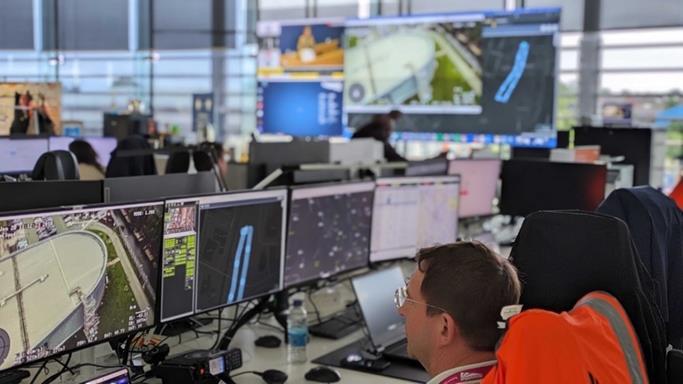
Long range drones flying BVLOS are expected to speed up the verification and interception of trespassers, thereby reducing train downtime and potentially saving lives.
The CAA has approved use within a 10 km range. The drone operator remains at the control point, although the drone currently has to be visually monitored by observers.
CAA approval for fully BVLOR flying is planned for later.
Flight management software company Dronecloud, drone operator RUAS and drone manufacturers Velos Rotors and Evolve Dynamics have also set up a drone operations centre and drone pad at Network Rail’s Birmingham Rail Operating Centre for incident response and general infrastructure monitoring.
Network Rail’s infrastructure manager envisages that BVLOS drones could fill a gap between its existing line of site drones and its crewed helicopter. Maintenance staff could be directed to potential faults more quickly, and there could be a faster response to trespass incidents.
Dronecloud CEO Jan Domaradzki said the company’s vision is to deploy a managed service with multiple hubs and satellite drone ports which would ‘be a truly game-changing capability, opening the door for centralised mass-scale deployment of drones across all critical national infrastructure’.
Network Rail is a non-departmental public body of the Department for Transport with no shareholders, which reinvests its income in the railways.
Its main customers are the private train operating companies, responsible for passenger transport, and freight operating companies, who provide train services on the infrastructure that the company owns and maintains.
The UK rail network witnessed over 18,500 trespassing incidents last year, equating to almost one incident per mile of railway track. Trespass contributes significantly to delays, with annual performance delay costs estimated at £55 million pre-COVID-19.
Current methods for monitoring and resolving trespassing and vandalism are not only slow but pose risks to Network Rail staff. Rail workers face a safety risk of being hit by trains whilst working trackside, an occurrence every 18 to 24 months on average.
The drone alternative aims to improve railway efficiency and safety for passengers and staff, and reduce trespassing incidents.
It also lays the groundwork for a comprehensive drone network for monitoring and maintaining the entire Network Rail estate, promising further savings and reducing the GBP £1.9 billion spent annually on monitoring infrastructure issues across the railway network.